


+86-15339975475
info@archeanref.com
info@archeanref.com
+8615339975475
Wutongli, linyi, Shandong, China


Views: 0 Author: Site Editor Publish Time: 2026-08-03 Origin: Site


Sizing a commercial cooling system represents a critical financial and engineering decision for any facility. Undersizing leads directly to catastrophic product loss and inevitable equipment burnout. Conversely, oversizing drives up upfront equipment expenses and inflates long-term energy consumption. You simply cannot rely on basic square footage estimates to protect your valuable inventory. Proper sizing requires exact thermal load calculations, application-specific operating temperatures, and a deep understanding of modern refrigerant capabilities. Whether you run a bustling restaurant or a massive pharmaceutical storage warehouse, the physics of heat removal remain the same. By systematically evaluating load profiles, technical specifications, and application environments, facility managers and engineers can specify the exact unit required. We will guide you through calculating precise heat loads, matching compressor architectures to your needs, and evaluating suppliers for reliable, compliant commercial cooling.
Selecting the incorrect compressor size carries severe operational risks for commercial facilities. Many buyers mistakenly assume larger units provide better cooling margins. This misconception introduces significant engineering problems causing rapid system degradation.
A unit sized too large cools the refrigerated space too quickly. It shuts on and off rapidly in a destructive process called "short-cycling." Rapid cycling causes excessive wear on electrical contactors and mechanical bearings. It also results in poor humidity control inside the cold space. Because the unit runs for short durations, it fails to remove sufficient moisture from the air. Condensation can build up on products, leading to mold and spoilage. Eventually, this erratic operation leads to premature mechanical failure and unexpected downtime.
An undersized unit presents equally dangerous consequences. It runs continuously attempting to meet an impossible temperature set point. The compressor motor overheats from a complete lack of rest. Constant elevated temperatures cause internal oil breakdown and loss of lubricity. This inevitably leads to catastrophic compressor failure. You will also suffer from massive spoiled inventory because the box never reaches safe storage temperatures.
These engineering realities directly harm your operational bottom line. We frequently see unprepared operations face crippling downtime from failed equipment. Consider the following direct business impacts:
Choosing a properly sized commercial cooling refrigeration compressor prevents these expensive disruptions.
Engineers evaluate four distinct variables before specifying any commercial compressor. You must precisely define these parameters to guarantee reliable performance under all conditions.
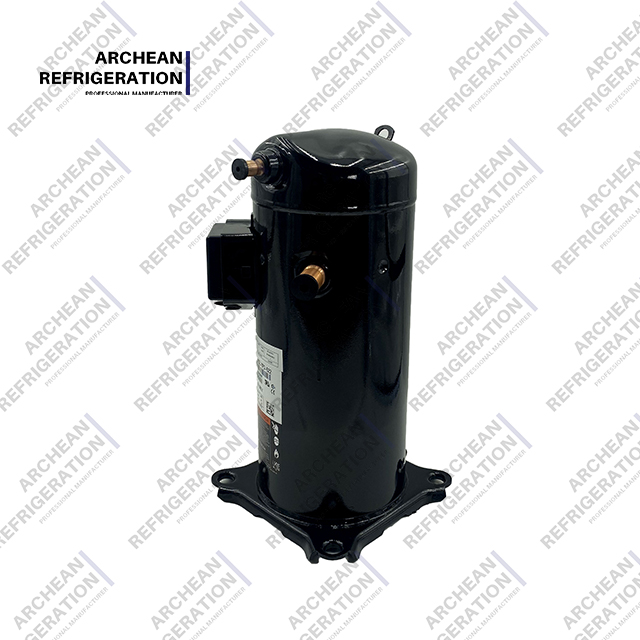
Different cooling applications demand specific compressor architectures. You must match the internal mechanical design to your physical operational environment. Analyzing detailed refrigeration compressor specifications helps engineers narrow their options effectively.
These units offer incredibly robust performance in highly variable load conditions. Semi-hermetic models provide a distinct serviceability advantage over fully sealed units. Technicians can unbolt the casing and rebuild them directly on-site. This makes them excellent choices for long-term commercial setups prioritizing repairability.
Scroll technology delivers superior volumetric efficiency by using two interlocking spiral scrolls. They feature a much lower noise footprint and generate significantly less vibration. This makes them absolutely ideal for medium-temperature commercial applications like neighborhood supermarkets and convenience stores.
Engineers universally specify screw compressors for massive, high-capacity cooling demands. They utilize heavy-duty helical rotors to compress the gas. They excel in heavy industrial food processing plants requiring continuous, large-scale thermal load management.
You should always evaluate technical features based on real-world operational outcomes. Advanced features only provide value if they solve a specific problem. Below is a comparison chart to help guide your technical decision-making process.
| Compressor Type | Best Application Environment | Key Performance Advantage | Typical Control Strategy |
|---|---|---|---|
| Semi-Hermetic Reciprocating | Variable load commercial cold rooms | Fully rebuildable and highly serviceable | Fixed-speed or staged capacity |
| Scroll | Supermarkets and quiet zones | High efficiency and low operational noise | Variable Frequency Drives (VFD) |
| Screw | Heavy industrial food processing | Massive cooling capacity for continuous loads | Slide valve capacity control |
Standard off-the-shelf models fit most typical walk-in coolers perfectly. However, specialized industrial or highly constrained commercial applications often require a heavily modified approach. You might need a custom refrigeration compressor to overcome unique facility challenges and maintain compliance.
Replacing older units in extremely tight mechanical rooms presents major logistical hurdles. Standard modern form factors often no longer fit into historical building layouts. Electrical infrastructures might also lack the capacity for standard startup surges. Custom designs allow you to adapt the physical unit dimensions and electrical components to your existing space.
Extreme ambient conditions easily destroy standard commercial equipment. Coastal locations expose unprotected metal parts to highly corrosive salt air. Heavy industrial settings, like manufacturing plants, generate intense mechanical vibrations. Custom units include specialty epoxy coatings, stainless steel hardware, and reinforced vibration dampeners to survive these environments.
Local energy codes grow stricter every single year. Custom engineering aids in meeting stringent municipal compliance targets. You may also need custom internal seals, specialized lubricants, and modified valves to handle natural refrigerants safely. Systems utilizing CO2 or Ammonia operate at extreme pressures requiring purpose-built components.
Custom-engineered units require exceptionally careful project management. They always carry extended manufacturing lead times causing facility launch delays. We strongly warn against skipping rigorous Factory Acceptance Testing (FAT). You must demand documentation verifying system performance before the custom unit ever ships to your facility.
Your chosen supplier heavily influences your overall project success. A great supplier acts as an expert engineering partner rather than a simple hardware distributor. You must evaluate every potential refrigeration compressor supplier carefully to ensure long-term support.
A highly qualified supplier provides detailed compressor performance envelopes and operational curves. They should actively assist your team with complex BTU/hr load calculations. Avoid vendors who simply take orders without asking questions or validating your system design criteria.
You must assess their overall supply chain transparency. A supplier's ability to quickly source OEM replacement parts directly impacts your facility's operational uptime. Ask them directly about their regional stock levels for critical replacement components like contactors, valves, and control boards.
Always look for comprehensive, multi-year warranty coverage. Accessible engineering support is vital for smooth system commissioning. You will also heavily rely on their technical expertise for advanced troubleshooting and long-term lifecycle maintenance strategies.
Take immediate, practical action to secure the right commercial partner. Request official performance curve sheets for your proposed compressor model. Verify all warranty terms and service level agreements in writing. Finally, cross-check the supplier's historical track record in your specific industry vertical.
Successful commercial cooling depends entirely on precise heat load mathematics. You must accurately match the proper compressor architecture to your specific facility application. Balancing upfront equipment investments with long-term mechanical reliability ensures highly profitable, uninterrupted operations. Ignoring these principles leads to catastrophic equipment failure and massive inventory loss.
We strongly advise all buyers to finalize their ambient and product load data first. Gather this critical operational information before approaching any manufacturer or wholesale distributor. Guessing your thermal load will only lead to expensive failures and wasted capital. Accurate data guarantees accurate equipment selection.
Consult an experienced commercial applications engineer today. They can rigorously validate your sizing calculations and review your specific facility requirements. Proactive engineering design guarantees your cooling system will perform reliably for many years to come.
A: No. Horsepower is an outdated and inaccurate metric for determining cooling capacity. Always size your equipment based on the Total Heat Load (BTU/hr) at specific evaporating and condensing temperatures. Relying solely on HP often leads to improperly matched systems and highly inefficient cooling performance.
A: You must factor in peak summer temperatures to determine your Saturated Condensing Temperature (SCT). High ambient heat reduces a condenser's physical ability to reject heat. Ensure you select a compressor with enough volumetric capacity to maintain target cooling loads during these worst-case weather scenarios.
A: Yes, it often does. Different refrigerants possess unique thermodynamic properties and volumetric efficiencies. Dropping a new, low-GWP refrigerant into an existing system alters the actual cooling capacity. You must conduct a full specification review to ensure the compressor size matches the new gas perfectly.
A: While quick estimations exist for initial budgeting, you should never blindly rely on rules of thumb. Generic estimates fail to account for unique infiltration rates, product loads, and local ambient conditions. Final purchasing decisions must always rely on a formal, mathematically sound heat load calculation.


