


+86-15339975475
info@archeanref.com
info@archeanref.com
+8615339975475
Wutongli, linyi, Shandong, China


Views: 0 Author: Site Editor Publish Time: 2026-11-02 Origin: Site


A compressor crankcase heater helps limit refrigerant accumulation in the compressor oil during shutdown. Selecting one requires more than matching the compressor’s physical size: the model, heater voltage, approved wattage, mounting arrangement, and control method all matter.
Start with the compressor manufacturer’s accessory reference and application instructions. A heater that fits around the shell is not necessarily approved for that compressor or suitable for the system’s operating conditions.
When a refrigeration system stops, refrigerant can migrate toward colder parts of the circuit and accumulate in the compressor. Refrigerant dissolved in the oil can reduce its lubricating effectiveness and contribute to foaming when the compressor starts.
A crankcase heater supplies heat to the relevant oil-containing area. Its purpose is to help control off-cycle refrigerant migration and reduce the risk of a flooded start.
Copeland’s guidance on liquid refrigerant control discusses crankcase heating as part of migration management. Heater effectiveness depends on the application; it is not an unlimited barrier against refrigerant accumulation.
A crankcase heater does not correct liquid floodback during operation, incorrect refrigerant charge, poor oil return, or unsuitable system piping. Those conditions require separate diagnosis.
Do not treat repeated startup noise, oil foaming, or protection trips as proof that a larger heater is needed. Review the system and the compressor manufacturer’s requirements first.
Heater requirements vary between compressor families and system configurations. Relevant factors can include refrigerant charge, compressor location, shutdown duration, ambient temperature, and the arrangement of remote heat exchangers.
For example, Danfoss provides model-specific off-cycle migration instructions in its DCJ scroll compressor application guidelines. Such requirements should not be transferred automatically to another compressor series.
Give particular attention to outdoor installations, extended shutdowns, and arrangements where the compressor can become colder than other refrigerant-containing components. Wind exposure can also increase heat loss from an externally heated shell.
The application review should establish whether heating alone is sufficient or whether the manufacturer requires additional refrigerant management measures.
Record the full model and suffix from the nameplate. Include the refrigerant, lubricant information if available, and equipment model. Similar-looking compressors may use different heater accessories.
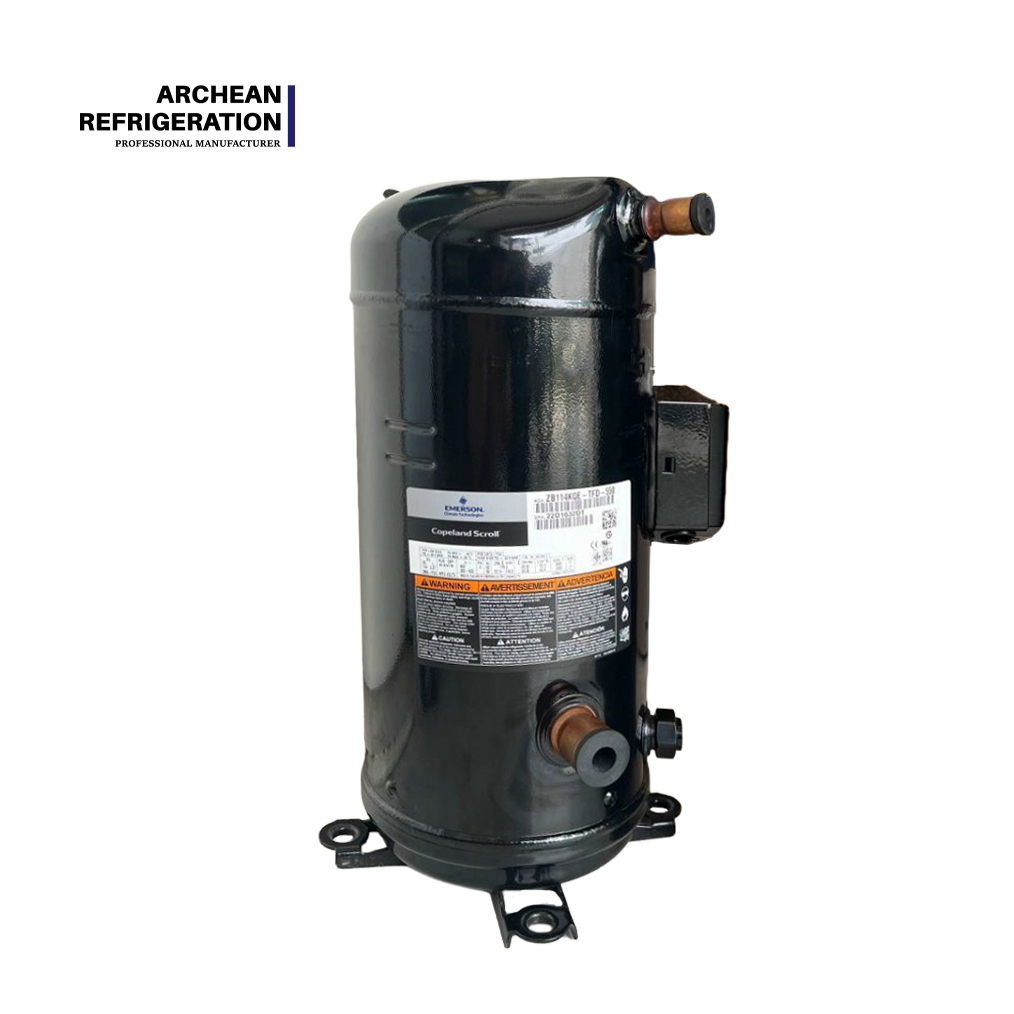
Compressor reference image. Confirm the full model before requesting a heater; the image does not establish heater inclusion or compatibility.
Archean’s refrigeration compressor range can help buyers identify the relevant product family. Use the exact model rather than brand or horsepower alone for an accessory inquiry.
Confirm the heater’s own supply voltage. It may be different from the compressor motor supply, so do not select it from the motor nameplate voltage alone.
Also check the rated power, connection type, cable requirements, and applicable electrical protection. The proposed control circuit must provide heating when required by the equipment design.
Higher wattage is not automatically better. The heater must provide the required thermal performance without exceeding the compressor or heater manufacturer’s limits.
External band heaters, flexible heating elements, and insertion heaters are different constructions. Use only the design approved for the compressor. An insertion heater requires a designated provision; a general-purpose heating tape is not automatically a suitable substitute.
Selection Item | What to Confirm |
|---|---|
Compressor identification | Full model, suffix, refrigerant, and approved accessory reference. |
Electrical rating | Heater voltage, rated wattage, connections, and protection requirements. |
Physical fit | Specified mounting location, dimensional range, fastening method, and clearances. |
Environment | Ambient conditions, wind, moisture exposure, and required environmental suitability. |
Controls | Required operating sequence, any temperature control, and pre-start heating instructions. |
For an external heater, contact with the shell and installation position affect heat transfer. Follow the specified fastening and routing instructions. Do not overlap, shorten, relocate, or cover the heater with insulation unless the manufacturer permits it.

Shell reference image only. The approved heater position must come from the compressor installation instructions.
Keep wiring clear of damaging heat, vibration, and sharp edges. Installation and electrical verification should be performed by qualified personnel using the equipment documentation.
Many applications require heating while the compressor is stopped. However, the exact switching arrangement and any requirement during operation depend on the approved system design.
Pre-start heating time is also model-specific. Do not apply one universal number after installation or a prolonged power interruption. Follow the relevant manual and confirm that the required heating conditions are achieved before starting.
A warm shell does not prove that the correct heater is fitted or that migration is controlled. Verification should include identification, electrical checks, mounting condition, and the manufacturer’s thermal or commissioning criteria.
If problems continue, investigate the refrigeration system rather than repeatedly increasing heater power. Review the available compressor manuals and resources and obtain the instructions for the exact model.
A complete inquiry helps avoid selection by appearance alone. Provide:
A clear compressor nameplate photo and full model number.
The existing heater part number and label photo, if available.
Heater supply voltage and the approved wattage, where known.
Mounting measurements, installation photos, and cable or connector requirements.
Refrigerant, application, ambient conditions, and typical shutdown duration.
Required quantity and destination market.
Ask the supplier to confirm the proposed part reference, compatibility basis, supplied components, and installation documentation. If an alternative is offered, request the technical basis for the substitution.
A: No universal rule applies. Follow the compressor manufacturer’s requirements for the model, refrigerant charge, and system arrangement.
A: Not reliably. Use the approved accessory reference and thermal requirements. Horsepower alone does not establish suitable wattage or mounting.
A: Only when the specific heating product is approved for that compressor and application. Material type alone does not establish electrical, thermal, or mounting suitability.
A: Off-cycle heating is required in many applications. Follow the approved control sequence, including instructions for seasonal shutdowns and power restoration.
A: It primarily addresses off-cycle migration. Liquid returning during operation requires separate investigation of system control, charge, piping, and other relevant conditions.


