


+86-15339975475
info@archeanref.com
info@archeanref.com
+8615339975475
Wutongli, linyi, Shandong, China


Views: 0 Author: Site Editor Publish Time: 2026-10-16 Origin: Site


Choosing a refrigeration compressor involves more than just picking the “best” model out of a catalog. You must align your equipment closely with your existing facility infrastructure. This choice requires a careful, highly specific calculation based on available power. Making the wrong decision often causes premature equipment failure. Alternatively, it leads to catastrophic electrical retrofit expenses down the road.
The underlying refrigeration cycle remains identical across most cooling systems. However, the method of electrical delivery fundamentally alters the motor design. Power supply types directly dictate starting torque, operational lifespan, and overall system efficiency. Facility operators face distinct mechanical advantages and strict limitations depending entirely on their local power grid.
This article delivers a detailed technical and financial evaluation framework. We wrote it to help facility managers, HVAC contractors, and commercial operators. You will understand the crucial engineering differences defining these standard cooling systems. We will show you exactly how to make evidence-based equipment specifications for your specific cooling needs.
When engineering a cooling system, power delivery mechanics dictate almost everything about motor performance. You must understand how electricity reaches the motor to accurately predict equipment behavior. The core differences stem directly from alternating current waveform structures.
Single-phase alternating current (AC) features distinct power peaks and zero-crossing points. The electrical wave constantly rises, hits a peak, drops to zero, and reverses direction. This pulsing power delivery creates a significant mechanical problem. A stationary motor resting at a zero-crossing point lacks the initial rotational force needed to overcome mechanical inertia. Manufacturers solve this by adding start capacitors and start relays to push the motor into motion.
Conversely, three-phase power utilizes three separate overlapping sine waves. These waves peak at sequential, evenly spaced intervals. Because the waves overlap, the combined power delivery never drops to zero. This ensures continuous, non-pulsating electrical flow directly to the motor windings. When comparing a single phase vs three phase compressor, this continuous energy delivery represents the most critical mechanical advantage.
Motor longevity connects directly to operational smoothness and internal heat generation. Single-phase systems inherently suffer from higher mechanical stress during every single startup sequence.
Technicians evaluate motors using Locked Rotor Amps (LRA) and Rated Load Amps (RLA). LRA measures the massive surge of electricity required to break the motor's stationary inertia. Single-phase units experience severe, sudden current spikes upon startup. This massive draw places immense strain on local electrical panels and breakers.
Three-phase units require a significantly lower starting current to begin spinning. Because the three overlapping waves naturally generate a rotating magnetic field, the motor turns almost effortlessly. A facility running multiple refrigeration racks will experience far less electrical strain during heavy startup periods if they utilize three-phase motors.
Financial evaluations often contain critical misconceptions regarding electrical efficiency. Many operators falsely assume industrial power configurations automatically slash monthly utility bills in half. We need to look at actual energy billing structures to find real operational savings.
You will often hear the misconception claiming three-phase equipment drastically reduces standard utility bills. This is technically misleading. Three-phase motors do possess an inherently better power factor. They also draw considerably fewer amps per individual electrical leg.
However, utility companies bill commercial customers by watts, specifically kilowatt-hours (kWh). Amperage represents only a portion of the total power equation. The raw cooling energy required to remove heat from a walk-in freezer remains practically identical regardless of phase. Moving 10,000 BTUs of heat out of a room requires a specific amount of wattage. Therefore, your base electrical consumption for actual cooling capacity stays relatively similar across both formats.
If raw wattage consumption remains similar, where do facility operators actually save money? The true return on investment hides in lifecycle maintenance and prolonged equipment durability.
Commercial utility bills differ wildly from residential power bills. Most commercial power grids implement strict demand charges. Utilities penalize facilities for sudden, massive peak amperage spikes.
Because single-phase systems pull massive Locked Rotor Amps (LRA) during startup, they frequently trigger these costly utility penalties. Three-phase units require much lower starting loads. In heavy-use environments where cooling equipment cycles on and off constantly, these lower starting currents keep facilities safely below expensive demand charge thresholds. This creates massive financial superiority over time.
| Metric | Single-Phase Compressors | Three-Phase Compressors |
|---|---|---|
| Power Delivery | Pulsating, relies on zero-crossing AC | Continuous, overlapping sine waves |
| Starting Components | Requires start capacitors and relays | Requires no external starting components |
| Starting Current (LRA) | Extremely high electrical surge | Significantly lower power spike |
| Vibration & Heat | Higher vibration, elevated internal heat | Smooth rotation, lower operating temps |
| Utility Demand Penalties | High risk due to massive startup spikes | Low risk due to efficient startup amps |
Engineering superiority means nothing if your building cannot physically support the equipment. The decision process almost always comes down to existing facility infrastructure. Attempting to force the wrong equipment into a building introduces severe implementation risks.
Grid availability serves as the ultimate primary dealbreaker for most commercial operators. The vast majority of residential homes, light-commercial strip malls, and small stand-alone retail buildings only receive 240V single-phase service from the street.
You cannot simply "plug in" industrial equipment into a standard electrical panel. Bringing new electrical lines to a building requires major municipal utility work. You must factor in trenching costs, new exterior transformers, and completely new interior breaker panels. Getting a utility provider to drop a dedicated three-phase line often costs tens of thousands of dollars. For small retail operations or independent restaurants, this heavy infrastructure upgrade remains entirely cost-prohibitive.
Some facility managers desperately want industrial-grade equipment but lack the necessary grid connection. They often attempt to utilize electrical workarounds. You can theoretically run industrial gear on basic power supplies by using Variable Frequency Drives (VFDs) or rotary phase converters. These devices artificially generate a third leg of power, mimicking an industrial grid supply.
Risk Warning: While technically feasible, these retrofits introduce significant operational risks. VFDs introduce parasitic power losses. The converter itself consumes electricity just to operate, typically wasting 3% to 5% of your total energy draw. Furthermore, improperly sized converters generate severe electrical harmonic distortion. This "dirty power" causes motors to run excessively hot. Most importantly, utilizing unauthorized phase converters will almost certainly void strict manufacturer warranties immediately upon installation.
Making the correct specification requires matching your cooling load to your specific building constraints. Use this practical framework to determine exactly which setup suits your upcoming project.
Do not upgrade unnecessarily if your operational parameters do not demand it. Stick with standard electrical configurations in these specific scenarios:
Certain industrial environments absolutely require continuous, robust power delivery to maintain operational stability. Specify heavy-duty electrical configurations for the following environments:
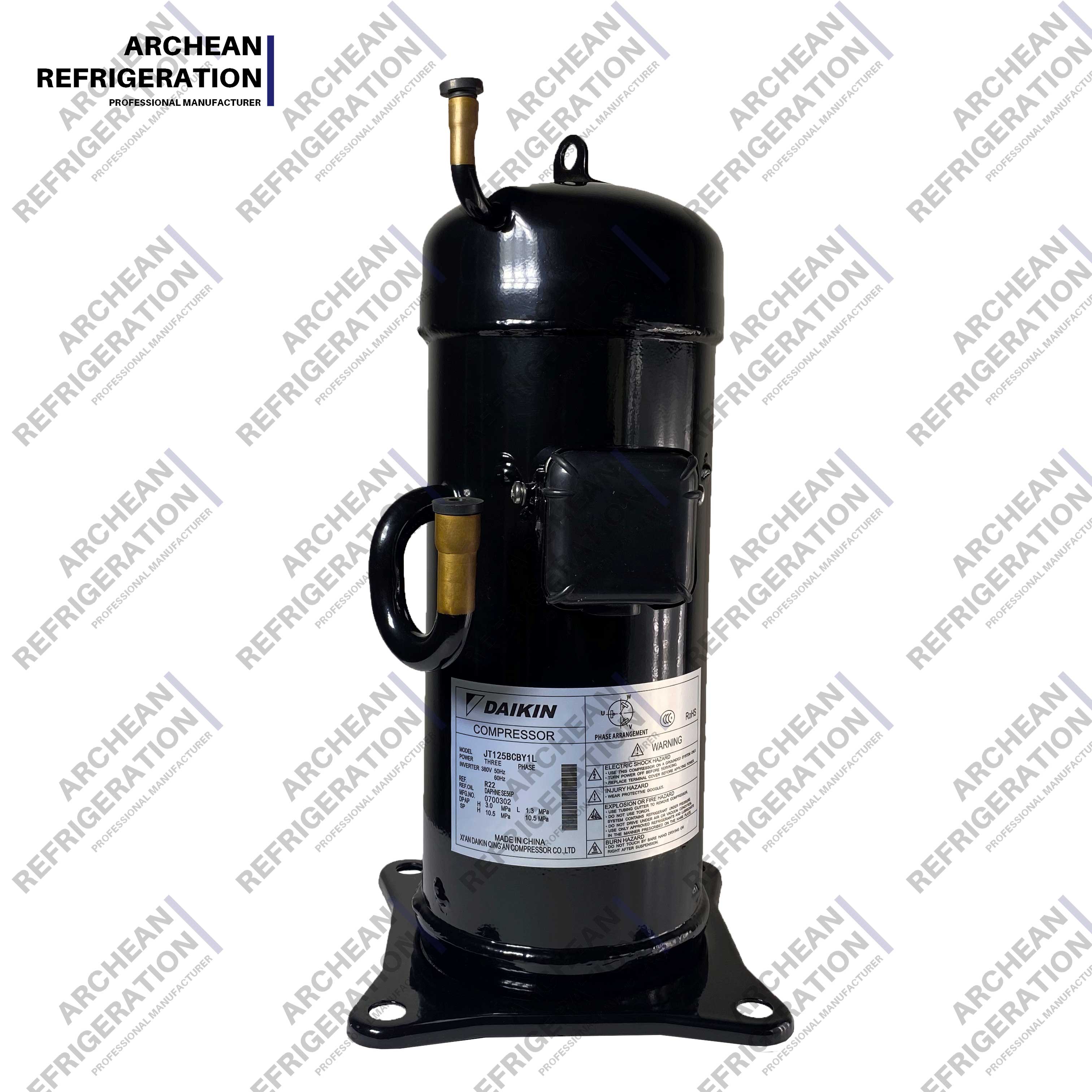
Fortunately, major refrigeration manufacturers design equipment families to accommodate both electrical constraints. You do not necessarily have to abandon your preferred brand just because of your electrical panel. For example, you can specify a highly reliable unit like a Daikin scroll compressor in both electrical configurations. This intelligent manufacturing approach allows buyers to focus entirely on site infrastructure rather than worrying about brand availability.
You must accurately identify your existing equipment before ordering replacement parts or planning system upgrades. Relying on guesswork leads to disastrous purchasing errors. Follow these verification steps to determine your current electrical configuration.
The fastest verification method involves reading the factory data tag physically riveted to the compressor shell. You should wipe away any grease or condensation to view the voltage notation box.
Look specifically for the middle number in the voltage sequence. A notation reading "208-230/1/60" explicitly indicates a single-phase unit. The "1" denotes the phase, while the "60" denotes the Hertz frequency. Conversely, notations reading "208-230/3/60" or "460/3/60" confirm you possess a three-phase unit. Always trust the factory nameplate above all other visual indicators.
Trained technicians often verify electrical setups by removing the terminal cover plate on the side of the compressor. The physical wiring arrangement tells an immediate story.
Standard motors feature three distinct terminal pins labeled Common (C), Start (S), and Run (R). The presence of these specific labels immediately confirms a standard residential-style configuration. Industrial motors utilize a completely different wiring nomenclature. Their terminals lack Start and Run designations. Instead, you will see pins labeled T1, T2, and T3 (or L1, L2, L3). These represent the three identical, continuous lines of incoming power.
Facility managers lacking technical training can still perform a basic visual check at the main electrical panel. You simply need to look at the electrical contactor relay supplying power to the outdoor condensing unit.
Observe the physical contactor poles where the thick electrical wires connect. A standard setup utilizes a contactor featuring only two physical poles (breaking two hot wires). An industrial setup utilizes a contactor featuring three distinct poles. Counting these connection points provides an immediate, highly reliable visual cue regarding your facility's power supply capabilities.
The ongoing debate regarding cooling equipment rarely centers on which model is objectively "better" in a vacuum. Instead, making the right choice requires aligning your equipment precisely with your building's existing electrical infrastructure and required cooling load. Specifying the wrong motor type guarantees either chronic mechanical failure or devastating structural retrofit costs.
As an actionable next step, you must firmly establish your building's baseline capabilities. Before soliciting any expensive equipment quotes, consult your facility’s main electrical panel. Speak directly with your local utility provider to confirm exact phase availability and evaluate potential commercial demand charges. Gathering this concrete electrical data ensures you specify a robust, highly efficient cooling system perfectly suited to your operational realities.
A: It draws fewer amps and has a better power factor, making the motor more efficient, but the total wattage (kWh) billed by the utility is roughly similar for the same cooling output.
A: Yes, via a phase converter or VFD, but it requires careful sizing, increases upfront installation costs, and can introduce electrical inefficiencies.
A: They rely on start capacitors and relays to initiate rotation. These auxiliary electrical components are sensitive to power fluctuations and high cycle rates, making them the most common point of failure.


