


+86-15339975475
info@archeanref.com
info@archeanref.com
+8615339975475
Wutongli, linyi, Shandong, China


Views: 0 Author: Site Editor Publish Time: 2026-10-30 Origin: Site


Does summer heat cause your system to fail? High temperatures directly slash your equipment's output. This inevitable thermal penalty leads to costly downtime and wrecked production schedules. In this engineering guide, we break down the exact physics behind this phenomenon. You will see how environmental variables interact with mechanical systems. More importantly, we provide actionable strategies to safeguard your industrial machinery against extreme weather.
Air Density Matters: Hotter environments lead to thinner air, which directly reduces overall mass flow and output.
The Derating Rule: Facilities must account for performance adjustments during the sizing phase to prevent summer shutdowns.
Pressure Spikes: Rising heat causes elevated discharge resistance. This forces the motor to draw significantly more electrical energy.
Cold Chain Vulnerability: Specialized refrigeration units face unique risks during heatwaves, threatening inventory safety.
Proactive Engineering: Improved ventilation and climate-resilient equipment selection effectively mitigate the effects of extreme heat.
To truly grasp how environmental conditions dictate industrial performance, we must examine the fundamental physics of gas compression. Heat fundamentally alters the physical properties of the air entering your intake valves. This initial change creates a cascading sequence of mechanical challenges.
Imagine a bustling manufacturing floor during a mid-July heatwave. The air feels stagnant. The mechanical room operates like a localized oven. As the surrounding temperature rises, the air molecules absorb thermal energy and rapidly expand. This natural expansion causes the air to become significantly less dense.
As engineers, we know a compressor functions as a constant-displacement machine. It is designed to pull in a fixed physical volume of air during every single intake stroke. However, because hot air is physically thinner, that fixed volume contains far less actual mass. With fewer air molecules entering the compression chamber per cycle, the machine processes less material. Consequently, it must run for longer durations and exert more mechanical effort. It fights to deliver the exact same amount of compressed gas that it would effortlessly produce on a crisp winter morning. This directly impacts your overall Compressor Capacity, leaving your facility starved for air or cooling power when you need it most.
Furthermore, extreme heat rarely acts in isolation. It is frequently accompanied by suffocating humidity. Hotter air possesses a substantially higher capacity to hold water vapor compared to cold air. When your system ingests this hot and humid atmosphere, it draws in a massive volume of water vapor alongside the necessary air molecules. Valuable electrical energy is wasted compressing this useless water vapor instead of pure gas.
For facility engineers and procurement managers, ignoring the uncompromising laws of thermodynamics during the equipment selection phase is a historically costly mistake. Relying exclusively on a machine's optimal laboratory rating will inevitably lead to severe undersizing in real-world applications.
In industrial engineering, Capacity Derating refers to the intentional reduction of a machine's rated output to account for harsh environmental conditions. Manufacturers typically establish their baseline ratings in tightly controlled environments. These are often set at 68 degrees Fahrenheit at sea level with zero percent relative humidity.
When a unit operates in a setting that drastically exceeds these pristine baseline conditions, it simply cannot produce its nameplate output. Applying a derating factor provides facility managers with a realistic expectation of what the machine can genuinely deliver under intense thermal stress.
To illustrate this impact, consider the following performance comparison for a standard industrial unit:
Operating Condition | Inlet Temperature | Relative Humidity | Effective Output Capacity | Motor Strain |
|---|---|---|---|---|
Factory Baseline | 68°F | 0% | 100% | Normal |
Moderate Summer | 90°F | 50% | Approx. 93% | Elevated |
Extreme Heatwave | 110°F | 80% | Approx. 85% or lower | Severe Risk of Overload |
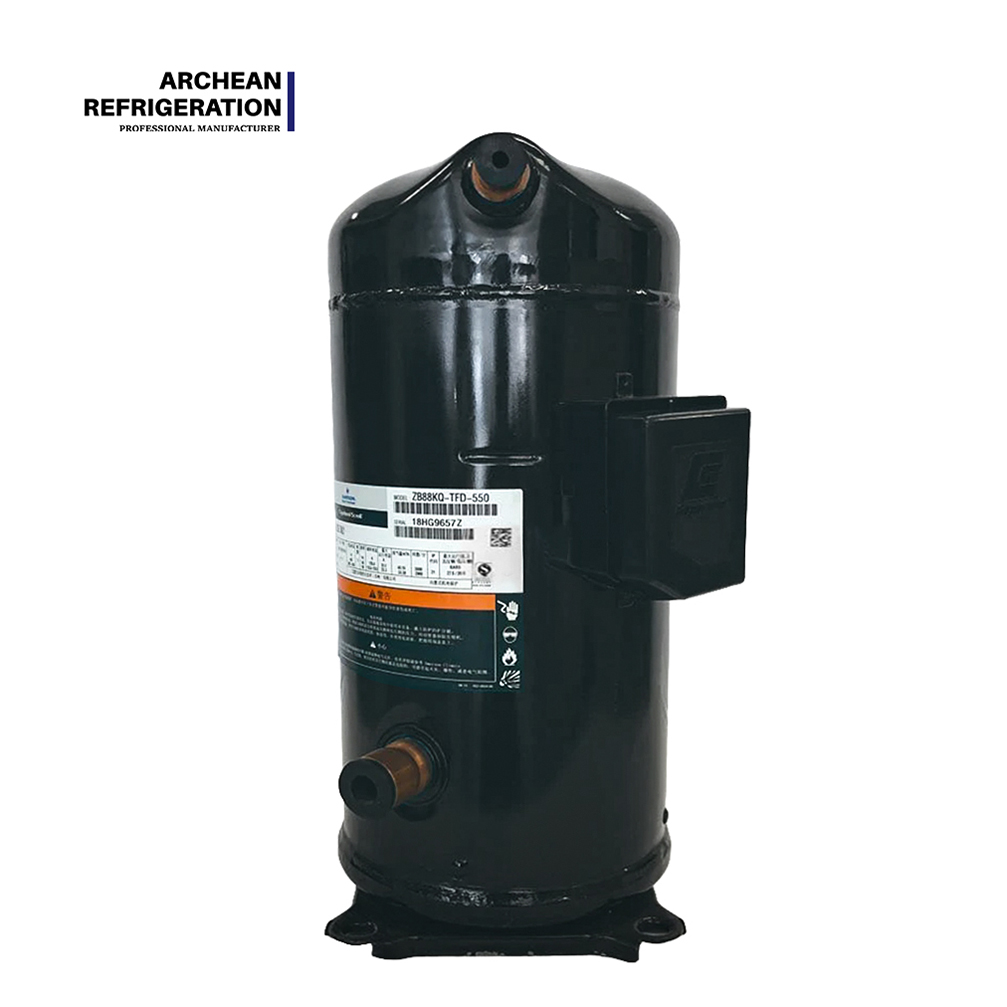
A widely accepted industry baseline dictates that for every 10 degrees Fahrenheit rise above the standard rating temperature, overall efficiency drops by roughly one to two percent. Failing to account for this deficit during the purchasing phase guarantees summer pressure drops. This is exactly why selecting robust equipment with a broad operating envelope, such as the Copeland ZB series scroll compressors, is critical. Models like the ZB88KQ or ZB95KQ are engineered to maintain structural integrity and minimize efficiency loss even when ambient temperatures surge.
The detrimental impact of environmental heat extends far beyond the initial intake valve. In commercial cooling and refrigeration loops, the heat rejection process relies entirely on the surrounding environment. This triggers a ripple effect that strains every component in the mechanical chain.
The primary function of the condenser is to expel the thermal energy absorbed by the refrigerant into the outside air. To execute this efficiently, there must be a substantial temperature differential between the scorching refrigerant coils and the surrounding atmosphere.
When the weather becomes oppressively hot, this crucial temperature gap shrinks drastically. The Ambient Temperature is simply too warm to absorb the rejected heat effectively. To force the necessary thermal transfer to occur, the mechanical loop naturally elevates the temperature and pressure of the internal refrigerant. This dynamic results in a dangerous and rapid spike in Condensing Pressure.
Recent trend analysis within the global HVACR sector reveals a critical shift in how modern facilities approach thermal management. Driven by increasingly frequent extreme heat events, the industry is rapidly moving away from legacy baseline models. Current engineering standards prioritize climate-resilient architectures. Facility managers are actively specifying equipment with broader thermal operating envelopes. This strategic shift ensures systems can handle unpredictable pressure spikes without triggering catastrophic efficiency losses or safety shutdowns.
Elevated discharge pressure acts as a formidable physical wall of resistance. Pushing refrigerant against this intense resistance requires the motor to draw significantly more electrical amperage. Consequently, facilities experience a sharp spike in utility costs precisely when production margins are tightest.
While standard pneumatic systems undoubtedly suffer during heatwaves, specific applications face business-ending consequences if output drops. The food, beverage, and pharmaceutical sectors rely on uncompromising temperature control. This makes their infrastructure uniquely vulnerable to seasonal weather shifts.
A robust cold chain depends on maintaining strict sub-zero internal environments to preserve highly perishable inventory. During a severe summer heatwave, the thermal load penetrating the building's exterior insulation increases exponentially. At the exact moment the facility desperately requires maximum cooling power to combat this external heat infiltration, the high environmental temperature is simultaneously crippling the equipment's capabilities.
Because the mechanical loop has lost its effective operational margin, a Cold Storage Compressor is forced to run continuously just to inch toward the thermostat setpoint. Normal refrigeration cycles incorporate essential resting periods that allow internal motors to cool down and lubricating oils to settle.
When extreme weather forces a unit into a relentless continuous duty cycle, mechanical wear accelerates at an alarming rate. Bearings degrade. Seals weaken. The risk of catastrophic failure multiplies. Upgrading to high-ambient resilient equipment, such as the Copeland ZB66KQ or ZB76KQ low-temperature models, is not just an operational preference. It is a vital engineering necessity to protect high-value inventory from dangerous temperature excursions.
Procuring capital equipment based strictly on historical average weather data is a fundamental engineering error. To ensure unyielding reliability year-round, facility managers must adopt a proactive sizing strategy that accounts for absolute worst-case environmental scenarios. We must move away from abstract theories and apply concrete sizing standards.
Specifically, proper system sizing begins with accurate localized data collection. It is crucial to measure the actual temperature inside the mechanical room rather than relying on the local weather forecast. Because these rooms are notoriously under-ventilated and filled with heat-generating equipment, they frequently run 15 to 20 degrees hotter than the outdoor air.
Once the true maximum thermal load is established, engineers must apply the correct mathematical derating factor. The objective is to right-size the machine so it comfortably delivers the required output during the hottest month of the year without stumbling.
However, gross oversizing must be carefully avoided. A machine that is excessively large will suffer from severe short-cycling during the cooler winter months. Short-cycling prevents the motor from reaching its optimal operating temperature, leading to internal condensation and accelerated wear. Utilizing variable speed drive technology is a highly effective compromise. A variable speed unit can ramp up to its derated maximum during summer heatwaves and elegantly scale back its output during the winter.
While it is impossible to alter the fundamental physics of hot air, facility teams can implement rigorous maintenance protocols. Structural adjustments can significantly blunt the impact of extreme heat. Proactive care remains the absolute best defense against seasonal performance degradation.
The most critical step in safeguarding your equipment is ensuring it can breathe freely. Mechanical rooms must feature balanced ventilation to prevent the dangerous recirculation of exhaust heat. When the room climate is properly managed through structural airflow, cooling efficiency improves dramatically.
Implement this high-frequency summer maintenance checklist to protect your assets:
Route hot discharge air directly out of the building through aerodynamic ductwork. Do not allow it to dump back into the room and create a microclimate.
Utilize thermostatically controlled intake louvers and makeup air fans. This continuously replaces stagnant hot room air with cooler outside air.
Blow out accumulated dust and debris from cooler fins and radiators weekly. Clean fins maximize heat transfer and prevent dangerous discharge pressure spikes.
Inspect and replace restrictive intake filters monthly. A dirty filter chokes the machine, forcing it to work harder to draw in already thin air.
Monitor oil levels frequently. Extreme heat thins out industrial lubricants, causing a loss of hydrodynamic film between moving metal rotors. Switch to a high-temperature synthetic blend designed for summer operations if necessary.
Extreme environmental heat is an unavoidable operational challenge that poses a direct threat to industrial productivity. By causing air density to plummet and discharge pressures to spike, high temperatures inevitably reduce your system's overall output. Ignoring these thermodynamic realities will result in severe mechanical strain, inflated energy bills, and catastrophic downtime.
The most effective strategy is a proactive offense. Deeply understand the principles of performance derating. Conduct accurate localized site audits. Strictly adhere to a high-frequency summer maintenance schedule.
If your current infrastructure struggles to maintain pressure or temperature during the summer months, it is time to evaluate your equipment. Protect your capital investments and eliminate seasonal downtime by upgrading to climate-resilient solutions. Visit Archean HVACR to explore our comprehensive range of industrial cooling solutions, and find the exact Copeland ZB series compressor tailored to withstand your facility's most demanding thermal loads.
While precise figures depend on the specific engineering of the machine and its altitude, a widely accepted general rule in thermodynamics applies. For every 10 degrees Fahrenheit rise in intake air temperature above the standard baseline rating, overall efficiency and output drop by roughly one to two percent. This reduction occurs because hot air is physically less dense, meaning fewer air molecules are drawn into the compression chamber during each intake stroke.
Most standard industrial units are engineered and factory-rated for optimal operation in environments up to 104 degrees Fahrenheit. Operating standard equipment above this threshold significantly increases the risk of thermal overload and automatic safety shutdowns. However, for facilities located in extreme climates, manufacturers offer specialized high-ambient models. These feature oversized coolers and upgraded ventilation systems that can safely operate in temperatures reaching up to 122 degrees Fahrenheit.
When environmental heat limits the system's ability to reject thermal energy, internal pressures naturally spike. To overcome this elevated resistance and maintain the cooling cycle, the electric motor must exert significantly more mechanical torque. This increased effort translates directly to a higher electrical amperage draw. Consequently, even a minor loss in overall efficiency can lead to a disproportionately large and noticeable spike in your facility's monthly utility costs.
You cannot alter the fundamental laws of physics or change the density of the hot outdoor air. However, you can effectively mitigate the operational impact through engineered facility improvements. Installing intake ducting that pulls cooler air from a shaded area outside helps immensely. Utilizing positive pressure ventilation in the mechanical room and keeping all heat exchangers spotlessly clean will artificially lower the temperature of the air entering the machine, thereby restoring lost efficiency.
The unit runs continuously due to a compounding thermal deficit. First, the high external heat increases the thermal load on the refrigerated space, requiring significantly more cooling power to maintain the setpoint. Simultaneously, the hot environment causes a physical reduction in the machine's actual output capabilities. Because it is delivering less cooling power per minute while fighting a much larger heat load, it must run longer cycles just to prevent temperature excursions.
The most obvious indicator is a severe drop in system pressure or a failure to reach thermostat setpoints during peak afternoon temperatures. If your unit runs continuously without cycling off, triggers high-temperature alarms, or requires auxiliary cooling fans pointed at the motor just to stay online, your equipment is critically undersized for the current environmental load.
High humidity compounds the stress of high temperatures. When ambient air is heavily saturated with moisture, the condenser coils must work harder to reject heat. In air compression systems, drawing in humid air means the machine wastes valuable mechanical energy compressing water vapor instead of usable gas. This excess moisture then condenses inside the piping, displacing usable volume and accelerating internal corrosion.


